
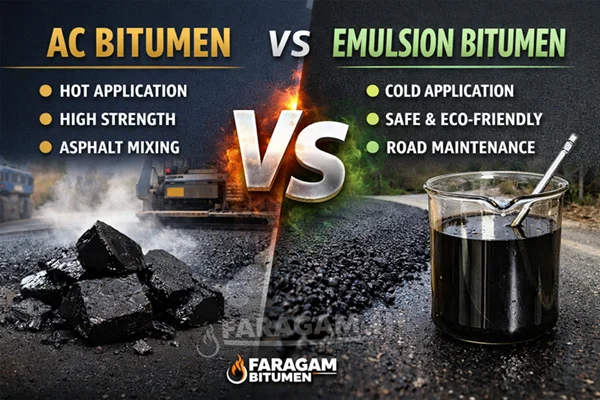
AC Bitumen vs Bitumen Emulsion: Key Differences, Applications, and How to Choose
In road construction and industrial asphalt applications, choosing the correct bitumen type directly affects performance, cost, and project durability. Two of the most commonly compared materials are AC Bitumen (Asphalt Cement) and Bitumen Emulsion.
While both originate from petroleum refining, their behavior, application methods, and suitability for different environments are fundamentally different.
This article explains the real, practical differences between AC Bitumen and Bitumen Emulsion—from composition to application—so contractors, importers, and project managers can make confident decisions.
What Is AC Bitumen (Asphalt Cement)?
AC Bitumen, also known as Asphalt Cement, is a pure petroleum-based binder produced during crude oil refining. It is a thermoplastic material, meaning it must be heated to high temperatures (typically 150–170°C) before it can be mixed or applied.
Key Characteristics of AC Bitumen
-
Supplied in solid or semi-solid form
-
Requires heating before use
-
High bonding strength
-
Excellent performance under heavy traffic loads
AC Bitumen is widely used in hot mix asphalt (HMA) production for highways, airports, and heavy-duty pavements.
What Is Bitumen Emulsion?
Bitumen Emulsion is a mixture of bitumen, water, and an emulsifying agent, allowing bitumen to be used without heating. The bitumen is dispersed as microscopic droplets in water, making it safer, cleaner, and more environmentally friendly during application.
Key Characteristics of Bitumen Emulsion
-
Can be applied at ambient temperatures
-
Lower energy consumption
-
Safer handling and transport
-
Excellent for cold or remote regions
Bitumen emulsions are commonly used in surface dressing, tack coats, prime coats, and maintenance works.
AC Bitumen vs Bitumen Emulsion: Core Differences
Comparison Table
| Feature | AC Bitumen (Asphalt Cement) | Bitumen Emulsion |
|---|---|---|
| Physical Form | Solid / Semi-solid | Liquid |
| Application Temperature | High (Hot application) | Ambient / Cold |
| Water Content | None | Contains water |
| Energy Requirement | High | Low |
| Safety | Requires heating & control | Safer to handle |
| Environmental Impact | Higher emissions | More eco-friendly |
| Typical Use | Hot mix asphalt | Surface treatment & maintenance |
| Storage & Transport | Heated tanks | Standard tanks |
Application Differences in Real Projects
AC Bitumen Applications
-
Highway and expressway paving
-
Airport runways
-
Heavy-load industrial roads
-
Asphalt concrete production plants
AC Bitumen is preferred when long-term durability and structural strength are critical.
Bitumen Emulsion Applications
-
Tack coat and prime coat
-
Rural road construction
-
Cold climate projects
-
Road maintenance and repair
Bitumen Emulsion excels where speed, safety, and ease of application matter more than heavy structural load.
Which One Should You Choose?
The choice between AC Bitumen and Bitumen Emulsion depends on project conditions, not preference.
-
Choose AC Bitumen if:
-
You operate a hot mix asphalt plant
-
Heavy traffic resistance is required
-
Long-term structural performance is critical
-
-
Choose Bitumen Emulsion if:
-
Heating facilities are unavailable
-
You are working in cold or remote areas
-
Environmental or safety regulations are strict
-
Many large infrastructure projects use both materials, each in the stage where it performs best.
Why Faragam Bitumen Is a Reliable Supplier for Both Grades
Faragam Bitumen supplies both AC Bitumen and Bitumen Emulsion to international markets with consistent quality and export-ready logistics.
Our Key Advantages
-
Stable quality control and standard specifications
-
Export experience across Asia, Africa, and Europe
-
Flexible packaging and shipping options
-
Full documentation: COA, MSDS, SGS (upon request)
-
Ability to receive payments through company bank accounts in UAE, Turkey, and Hong Kong, ensuring smooth and reliable international transactions
Faragam Bitumen is not just a supplier—we are a long-term partner for infrastructure and industrial projects.
Frequently Asked Questions (FAQ)
What is the main difference between AC Bitumen and Bitumen Emulsion?
AC Bitumen requires heating and offers higher structural strength, while Bitumen Emulsion can be applied cold and is easier to handle.
Is Bitumen Emulsion weaker than AC Bitumen?
Not weaker—just designed for different purposes. Emulsion is ideal for surface treatments and maintenance, not heavy structural layers.
Can both products be used in the same project?
Yes. Many road projects use bitumen emulsion for prime or tack coats and AC bitumen for the asphalt layers.
Does Faragam Bitumen export both products?
Yes. Faragam Bitumen exports AC Bitumen and Bitumen Emulsion with international-standard packaging and documentation.
Final Thought
Understanding the difference between AC Bitumen and Bitumen Emulsion is not academic—it directly affects project success, cost efficiency, and durability.
Choosing the right material, from a reliable supplier, is where engineering meets smart procurement.
Faragam Bitumen stands ready to support both.


