
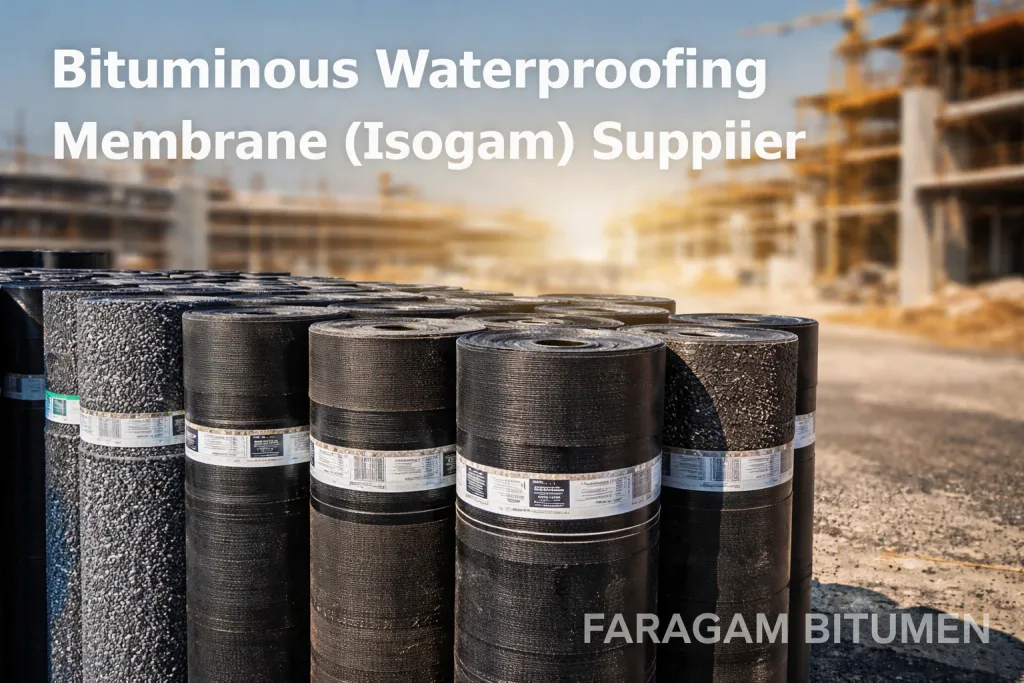
Bituminous Waterproofing Membrane (Isogam) Supplier
Bituminous Waterproofing Membrane, commonly known as Isogam, is one of the most widely used waterproofing materials in construction and infrastructure projects. Due to its durability, flexibility, and resistance to moisture penetration, Isogam plays a critical role in protecting buildings against water damage.
Faragam Bitumen supplies high-quality Bituminous Waterproofing Membranes suitable for different climates, applications, and project requirements, ensuring long-term performance and export-grade reliability.
What Is Bituminous Waterproofing Membrane (Isogam)?
Bituminous Waterproofing Membrane is a factory-produced sheet made from bitumen, reinforced with polyester or fiberglass, and modified with polymers such as APP (Atactic Polypropylene) or SBS (Styrene-Butadiene-Styrene).
It is typically installed using torch application and forms a seamless, water-resistant barrier.
This material is widely used in roofing, basements, foundations, tunnels, bridges, and other structures exposed to moisture.
Types of Bituminous Waterproofing Membrane
Faragam Bitumen offers a wide variety of Isogam types, allowing buyers to select the most suitable membrane based on climate, structural movement, and application method.
Main Classification Criteria
-
Bitumen modification type (APP / SBS)
-
Reinforcement material (Polyester / Fiberglass)
-
Thickness and roll dimensions
-
Surface finish (Polyethylene film, mineral granules, aluminum foil)
Comparison Table: Isogam Types and Specifications
| Type | Reinforcement | Thickness (mm) | Roll Size (m²) | Diameter (cm) | Typical Applications |
|---|---|---|---|---|---|
| APP Membrane | Polyester | 3 – 4 | 10 | 15 – 18 | Flat roofs, industrial buildings |
| SBS Membrane | Polyester | 3 – 5 | 10 | 16 – 19 | Cold climates, flexible structures |
| APP Membrane | Fiberglass | 3 – 4 | 10 | 14 – 17 | Foundations, damp-proofing |
| Mineral Surface | Polyester | 4 | 10 | 18 – 20 | Exposed roofing |
| Aluminum Foil | Polyester | 4 | 10 | 18 – 20 | Thermal insulation + waterproofing |
Specifications can be customized based on project and export requirements.
Key Applications of Isogam
Roofing Systems
Used extensively in residential, commercial, and industrial roofing for long-term water protection.
Foundations and Basements
Prevents groundwater penetration and structural moisture damage.
Infrastructure Projects
Applied in tunnels, bridges, and underground structures where waterproofing reliability is critical.
Industrial Facilities
Ideal for factories, storage areas, and power plants exposed to chemicals and weather fluctuations.
Quality Standards and Performance
Faragam Bitumen supplies Isogam manufactured under strict quality control, offering:
-
High tensile strength
-
Excellent flexibility at low temperatures
-
Strong adhesion to concrete and metal surfaces
-
Resistance to UV radiation and aging
-
Long service life in harsh environments
These features make Faragam’s Bituminous Waterproofing Membranes suitable for international construction standards.
Why Choose Faragam Bitumen as Your Isogam Supplier?
Reliable Export Supplier
Faragam Bitumen has proven experience in supplying waterproofing materials to international markets.
Wide Product Variety
Multiple grades, thicknesses, and reinforcement options tailored to different applications and climates.
Flexible International Payments
To facilitate global trade, Faragam Bitumen is able to receive payments through UAE, Turkey, and China bank accounts, ensuring smooth and secure transactions for international buyers.
Consistent Quality and Packaging
Export-grade packaging, palletizing, and documentation suitable for sea and land transportation.
Major Export Destinations for Bituminous Waterproofing Membrane (Isogam)
Bituminous Waterproofing Membrane (Isogam) is widely traded in international construction markets where durability, cost efficiency, and climate resistance are critical. Demand is strongest in regions with rapid urban development, infrastructure investment, and challenging weather conditions.
Middle East Markets
Countries such as Iraq, UAE, Oman, Qatar, and Saudi Arabia are among the most active importers of Isogam. High temperatures, flat-roof architecture, and large-scale construction projects drive continuous demand for APP-modified and mineral-surfaced membranes. Iranian Isogam is well accepted in these markets due to its performance-to-price ratio.
Africa
Kenya, Tanzania, Nigeria, Ghana, Ethiopia, and Algeria represent fast-growing markets for waterproofing membranes. Roofing and foundation waterproofing in residential and commercial buildings is the main application. Cost-effective, torch-applied membranes are preferred, making Iranian-origin products highly competitive.
CIS & Central Asia
Countries such as Armenia, Azerbaijan, Kazakhstan, Uzbekistan, and Turkmenistan import Isogam for both residential and infrastructure projects. Cold winters increase demand for SBS-modified membranes with higher flexibility at low temperatures.
South & East Asia
Markets including China, Pakistan, Sri Lanka, and Southeast Asian countries import bituminous membranes for industrial roofing, warehouses, and transportation infrastructure. Consistent quality and export documentation are key purchasing factors in these regions.
Faragam Bitumen supplies Isogam suitable for all these markets, with customized specifications based on climate and application requirements.
Export Advantages of Faragam Bitumen
Faragam Bitumen supports international buyers by offering:
-
Stable supply capacity for bulk and container shipments
-
Export-standard packing and labeling
-
Technical support for product selection
-
Flexible international payment options through UAE, Turkey, and China bank accounts
These advantages simplify procurement for distributors, contractors, and project owners worldwide.
Frequently Asked Questions (FAQ)
What is the difference between APP and SBS bituminous membranes?
APP membranes are more resistant to UV and high temperatures, making them suitable for hot climates. SBS membranes offer greater flexibility and perform better in cold environments.
What thickness of Isogam is most commonly used?
The most common thicknesses are 3 mm and 4 mm, depending on application. Roofs often require thicker membranes, while foundations may use thinner grades.
Can Isogam be customized for specific projects?
Yes. Faragam Bitumen can supply membranes with customized thickness, reinforcement type, and surface finish based on project requirements.
What is the typical roll size of Bituminous Waterproofing Membrane?
Standard rolls usually cover 10 square meters, though diameter and weight vary depending on thickness and reinforcement.
How does Faragam Bitumen handle international payments?
Faragam Bitumen can receive payments through UAE, Turkey, and China bank accounts, enabling smooth and secure transactions for international buyers.


