
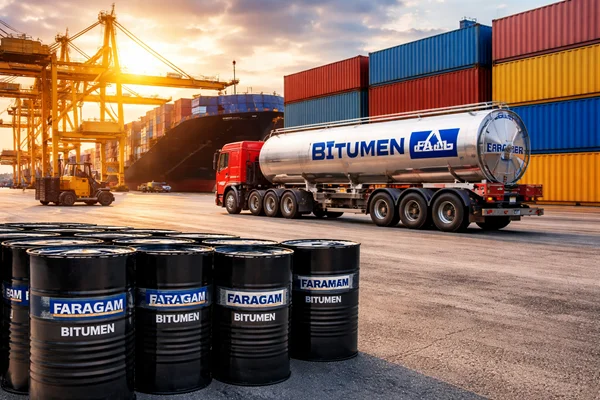
Bitumen Importers: Global Trends, Seasonal Fluctuations & Faragam Bitumen Supply
Introduction
The global bitumen market constitutes a critical, technically complex, and economically volatile segment of the international energy and infrastructure landscape. As the fundamental binding agent in asphalt for road construction, roofing membranes, and industrial waterproofing, bitumen serves as a primary indicator of macroeconomic health and infrastructure development. However, unlike lighter petroleum distillates such as gasoline, diesel, or jet fuel—which benefit from standardized global pricing benchmarks and fungible supply chains—the international trade of bitumen is uniquely constrained by its physical properties. Its high viscosity, temperature sensitivity, and requirement for specialized heated logistics create a market environment that is heavily fragmented, intensely regional, and subject to a complex matrix of seasonal weather patterns, crude oil refining economics, and geopolitical trade flows.
The significance of bitumen in the global economy cannot be overstated. With a market size valued at approximately USD 73.35 billion in 2024 and projected to reach nearly USD 99 billion by 2032, the commodity underpins the construction of highway networks that facilitate global trade. It acts as the literal foundation of modern connectivity. Yet, the market is characterized by severe fragmentation. Import dependencies vary drastically; nations like India and China are voracious consumers driven by massive state-led infrastructure mandates, whereas European markets exhibit mature, maintenance-driven demand patterns heavily regulated by environmental standards. Furthermore, the supply chain is undergoing a structural transformation. The implementation of IMO 2020 and subsequent IMO 2025 regulations regarding marine fuel sulfur content, the rise of “green” procurement policies in the European Union, and the shifting refining capacities in the Middle East and Asia have altered traditional trade routes, creating both new challenges and opportunities for importers and suppliers alike.
Central to the analysis of this market is the phenomenon of seasonality. Bitumen consumption is intrinsically linked to the construction calendar, which is, in turn, dictated by meteorology. From the monsoon suspensions that freeze paving projects across the Indian subcontinent to the winter storage policies in China’s Shandong province and the freezing of operations in Northern Europe, seasonal variations dictate the ebb and flow of global trade. These fluctuations create a precarious environment for importers who must balance inventory holding costs against the risk of supply shortages and price spikes during peak paving seasons. The inability to navigate these cycles can result in project delays, cost overruns, and severe logistical bottlenecks.
Amidst these oscillating market dynamics, the role of reliable, adaptable suppliers becomes paramount. This report highlights the operational framework of Faragam Bitumen, a prominent supplier capable of navigating the intricacies of international sanctions, price volatility, and logistical hurdles to deliver consistent product grades to high-demand markets in Asia, Africa, and the Middle East. By examining Faragam’s adaptability to seasonal shifts and its diverse product portfolio—ranging from standard penetration grades to specialized cutbacks and emulsions—the report illustrates how agile suppliers act as stabilizers in a fluctuating global supply chain.
Through a detailed, exhaustive examination of trade data, regional market profiles, technical grade specifications, and seasonal econometric models, this document aims to equip stakeholders with a nuanced understanding of the forces shaping the global bitumen trade in 2025 and beyond. It explores not just who is buying bitumen, but when, why, and how the market is evolving in response to environmental pressures and logistical realities.
Section 1: Top Bitumen Importers Around the World
The global landscape of bitumen importation is defined by a sharp dichotomy between emerging economies with aggressive, government-backed infrastructure deficits and developed nations with extensive, yet aging, road networks requiring constant maintenance. In 2024 and heading into 2025, the center of gravity for bitumen demand has firmly entrenched itself in the Asia-Pacific region, though significant pockets of high-volume growth exist in Africa and distinct, high-value import markets operate within Europe and North America.
1.1 The Dominance of Asia-Pacific Importers
The Asia-Pacific region commanded a dominant market share of approximately 30.36% in 2024, driven primarily by urbanization, industrialization, and massive state-sponsored transport corridors. The import dynamics in this region are complex, involving both direct consumption for paving and the importation of “bitumen blends” for refining purposes, reflecting a sophisticated interplay between energy policy and infrastructure development.
1.1.1 China: The Strategic Consumer and the “Bitumen Blend” Phenomenon
China remains the undisputed heavyweight in the global bitumen market, operating as both a massive producer and a significant importer. In 2024, China imported approximately $1.41 billion worth of petroleum bitumen, a figure that belies the true scale of its consumption when domestic production is factored in. The structure of Chinese imports reveals a strategic diversification of sources designed to mitigate geopolitical risks and price volatility.
The primary origins of China’s bitumen imports include the United Arab Emirates ($405M), South Korea ($398M), and Singapore ($338M). Notably, the UAE serves as a critical transshipment hub, often re-exporting material from other Middle Eastern producers to obscure origins or consolidate bulk cargoes. However, a unique and critical characteristic of the Chinese market is the importation of “bitumen blend”—a heavy oil mixture often sourced from Venezuela or Malaysia. Between July 2024 and March 2025, China imported nearly 2.7 million tons of this blend. While technically labeled as bitumen or fuel oil mixtures to bypass crude oil import quotas allocated to independent “teapot” refineries in Shandong, much of this material is processed into paving-grade bitumen or used as feedstock for coking units. This “grey market” flow is essential for understanding the true volume of Chinese consumption and the price floors for heavy residues globally.
Infrastructure drivers in China are shifting. The Belt and Road Initiative (BRI) continues to drive consumption, but the nature of projects is evolving from new expressway construction to rural connectivity and the maintenance of the massive existing network. The consumption patterns are heavily localized; for instance, the East Coast and Shandong regions represent major entry points and consumption hubs, handling millions of tons annually. Recent data suggests a pivotal shift in 2025: imports of finished bitumen are facing pressure from domestic production, which is ramping up as refineries upgrade their bottom-of-the-barrel processing capabilities. However, the demand for specialized grades and high-quality imports from South Korea and Singapore remains robust for premium highway projects where domestic quality consistency is sometimes questioned.
1.1.2 India: The Growth Engine and the Iraqi Dominance
India stands as the world’s largest importer of bitumen by volume relative to domestic production capacity shortfalls. With road construction aiming for 35,000 km of highways under the Bharatmala Pariyojana and other schemes, the demand-supply gap is bridged almost entirely by imports. The Ministry of Road Transport and Highways (MoRTH) continues to push for rapid expansion, creating a relentless demand for binder material.
In the fiscal year 2023-24, India’s consumption hit 8.8 million metric tons, with projections increasing to 10 million tons for 2024-25. Approximately 50% of this demand is met through imports, costing the nation between INR 25,000–30,000 crore annually. This heavy reliance on foreign supply makes India highly sensitive to global price fluctuations and freight rates.
The Indian market is characterized by extreme supplier concentration. In October 2025, data indicated that Iraq supplied a staggering 71% of India’s bitumen imports, followed by the UAE at 22%. This dominance underscores the price sensitivity of Indian contractors, who favor the competitive pricing of Middle Eastern bulk cargoes over more expensive sources from Southeast Asia or Europe. However, this over-reliance on a single source creates supply security risks, prompting some major Indian buyers to explore diversification strategies, including sourcing from Iran via suppliers like Faragam Bitumen, despite the complex compliance landscape.
Grade preferences in India are distinct. The market predominantly consumes Viscosity Grades (VG), specifically VG30 and VG40, which are suited for the country’s tropical climate and heavy traffic loads. VG10 is imported in smaller quantities for colder northern regions and spraying applications. The transition from penetration grades (60/70) to viscosity grades has been largely successful in the organized sector, though 60/70 remains popular in secondary road networks. Port dynamics also play a crucial role; the West Coast of India (Mundra, Kandla, Mumbai) handles the bulk of imports from the Persian Gulf due to proximity, with delivery times averaging 10-25 days. The East Coast (Haldia, Chennai) services infrastructure projects in the developing eastern states but faces longer lead times and higher freight costs.
1.1.3 Vietnam: Rising Demand and Source Shifting
Vietnam has emerged as a significant importer in Southeast Asia, importing 1.14 million tons in 2024, a 10% increase year-on-year. The country’s import strategy highlights a broader regional trend: the structural shift away from expensive Northeast Asian suppliers toward Middle Eastern sources.
Imports from the Middle East to Vietnam surged by 49% in 2024, totaling 382,000 tons. This dramatic shift was driven by pure price arbitrage; Middle Eastern cargoes traded at discounts of nearly $130/t compared to Singaporean assessments. Conversely, imports from South Korea and China dropped significantly due to higher FOB prices and freight costs. The demand is fueled by the aggressive completion of north-south expressways and diverse industrial zones. The Vietnamese market is highly price-sensitive, with importers utilizing bulk carriers to maximize economies of scale despite the longer voyage times from the Persian Gulf. This market behavior mirrors India’s, reinforcing the Middle East’s status as the critical supplier for developing Asia.
1.2 The African Import Landscape: The Frontier of Growth
Africa represents a high-growth frontier for bitumen exporters. The continent’s lack of refining capacity, combined with massive, multi-national road corridor projects, necessitates a heavy and growing reliance on imports.
-
Nigeria: Despite being a major crude oil producer, Nigeria’s lack of functional bitumen refining capacity makes it a top importer. The country relies on the UAE and Europe for supplies to feed its road rehabilitation projects. However, port congestion and logistics inefficiencies often inflate the landed cost of the commodity, making drummed bitumen a viable alternative to bulk for inland delivery.
-
East Africa (Kenya & Tanzania): This sub-region functions as a connected market, integrated by corridor projects.
-
Kenya: Annual demand ranges between 200,000-250,000 MT, driven by the LAPSSET (Lamu Port-South Sudan-Ethiopia-Transport) corridor and the Nairobi-Mombasa highway. Mombasa Port acts as the entry hub, not just for Kenya, but for landlocked neighbors like Uganda and South Sudan.
-
Tanzania: Importing 180,000-220,000 MT annually, Tanzania utilizes Dar es Salaam and Mtwara ports. The construction of the Standard Gauge Railway (SGR) and port expansion projects drive demand for both penetration grades (60/70) and cutbacks.
-
-
South Africa: Historically a producer, recent refinery closures (such as SAPREF and ENREF) have turned South Africa into a net importer. The market is sophisticated, requiring high-quality Performance Grade (PG) bitumen and modified binders. The shift to imports has necessitated significant upgrades to storage and handling terminals in Durban and Cape Town to handle bulk shipments.
1.3 Europe and the Middle East: Transit Hubs and Mature Markets
While Europe is often seen as a mature market with flat growth, specific countries remain substantial importers due to the rationalization of the refining sector and the need for specialized binders.
-
Turkey: Acting as a bridge between Europe and Asia, Turkey is both a consumer and a transit hub. In 2023, Turkey imported $786 million worth of petroleum bitumen products. While it exports to Europe, it imports specific grades to balance domestic refinery outputs. The market is forecasted to grow steadily, with import values expected to reach $149 million in 2024 for specific sub-categories. Turkey’s strategic position allows it to arbitrage between Russian, Iraqi, and Mediterranean supplies, blending and re-exporting to Europe.
-
United States: The US remains a colossus in the global trade, importing $2.42 billion in 2024, primarily from Canada ($2.18B). The dynamics here are unique; the US imports heavy crude and bitumen from Canada via pipeline and rail for processing in complex refineries, while also importing finished asphalt for coastal infrastructure. Trade tensions and tariffs have begun to reshape these flows, with reciprocal tariffs potentially affecting supply chains from secondary sources.
1.4 Data Summary: Top Importers (2024 Estimates)
The following table summarizes the key importers, their primary sources, and the dominant grades driving their demand.
| Country | Primary Import Sources | Key Demand Drivers | Dominant Grades | Trend Status |
| China | UAE, S. Korea, Singapore, Venezuela (via Malaysia) | Belt & Road, Rural Connectivity, Maintenance | 60/70, 80/100, PMB | Stabilizing/Internalizing |
| India | Iraq (71%), UAE, Iran | Bharatmala Pariyojana, Urbanization | VG30, VG40, VG10 | High Growth |
| United States | Canada, Mexico, Spain | Interstate Maintenance, New Housing | PG Grades, 60/70 | Stable/High Volume |
| Vietnam | UAE, Iran, Singapore | North-South Expressway | 60/70, Emulsions | Growing/Shifting Source |
| Nigeria | Europe, UAE | National Road Networks | 60/70, Cutbacks | Import Dependent |
| Kenya/Tanzania | UAE, Iran, India | LAPSSET, SGR, Regional Corridors | 80/100, 60/70 | High Growth |
| Turkey | Russia, Iraq, Europe | Reconstruction, Transit Trade | 50/70, 70/100 | Volatile/Strategic |
This data illustrates a global market that is interconnected yet distinct. While China and India drive volume through massive construction projects, markets like Nigeria and Kenya represent the future growth nodes where infrastructure deficits are being addressed through imported materials. Understanding these flows is crucial for suppliers like Faragam Bitumen, who position themselves to bridge the gap between production surplus in the Middle East and consumption deficits in Asia and Africa.
Section 2: Seasonal Variations and Market Fluctuations in Bitumen Import Trends
Unlike standard petrochemicals or dry bulk commodities, bitumen usage is physically constrained by meteorology. You cannot pave in a monsoon, and you cannot lay asphalt effectively in freezing temperatures without expensive additives or specialized technology. Consequently, global bitumen trade flows follow a distinct, predictable, yet volatile seasonality that impacts pricing, freight rates, storage utilization, and project financing.
2.1 The Indian Monsoon: A Market Stop-Watch
Nowhere is seasonality more pronounced than in India, the world’s largest open market for bitumen imports. The Southwest Monsoon (June to September) acts as a hard brake on construction activity across the subcontinent, creating a cyclical boom-and-bust pattern for importers.
-
Pre-Monsoon Rush (March-May): As the fiscal year ends and the weather holds, importers and contractors engage in aggressive buying to complete projects before the rains arrive. Prices typically peak during this window as demand outstrips supply, and port congestion increases at major hubs like Mumbai and Mundra. Importers rush to clear cargoes, driving up spot premiums.
-
The Lull (June-September): Import volumes plummet. For instance, in historic data from August 2021, demand fell for the fifth consecutive month due to the monsoon. During this period, Indian ports often see high inventory buildups as cargoes arriving late cannot be moved inland due to flooded roads and halted sites. Pricing power shifts entirely to buyers, and importers often face demurrage costs due to slow offtake. This is a critical period where financial liquidity for importers tightens significantly.
-
Post-Monsoon Surge (October-February): As the rains subside, a massive release of pent-up demand occurs. In August 2025, for example, India saw a 47% year-on-year rise in bitumen demand as the country emerged from a wetter-than-usual season. Importers who stocked up during the lull capitalize on rising premiums. This period often coincides with the post-Diwali construction push, creating a “double peak” in demand.
2.2 The European Winter and Construction Hiatus
In Europe, particularly Northern and Central regions (Germany, Poland, Nordics), the bitumen market enters a hibernation phase from November to March. The physics of asphalt compaction dictates this pause; if the ambient temperature is too low, the asphalt mix cools too quickly to be compacted to the required density, leading to premature road failure.
-
Operational Shutdowns: Asphalt plants close for maintenance during winter due to thermal inefficiencies and quality risks. This leads to a precipitous drop in spot demand. For example, in late 2025, demand in the Nordics and Baltics faded significantly as freezing temperatures set in.
-
Price Inversion: During winter, bitumen prices in Europe often decouple from crude oil. While crude prices might rise due to heating oil demand, bitumen prices can stagnate or fall due to a lack of physical offtake. However, sophisticated importers utilizing storage terminals (like those in Antwerp or Rotterdam) use this period to build inventory at lower prices (“contango” strategies), anticipating the spring restart.
-
Southern Resilience: Conversely, Southern Europe (Spain, Italy, Greece) and the Mediterranean market maintain some activity levels, creating a bifurcated market where “Med” cargoes might still trade at a premium while “North Sea” markets are dormant. This geographic split allows suppliers with flexible logistics to divert cargoes from north to south during the winter months.
2.3 China’s “Winter Storage” Policy
China’s market has evolved a sophisticated mechanism to handle seasonality, specifically the “Winter Storage” policies in Shandong province, a key refining and import hub.
-
Structured Inventory: Authorities and refineries have introduced directives to maintain structured inventory targets during the low-demand winter months (December-February). Instead of shutting down production or halting imports entirely, refineries continue to run, building vast stockpiles.
-
Market Impact: This policy smooths out the extreme volatility seen in previous years. It prevents a sudden supply shock in March when construction resumes. For importers, this means the purchasing cycle is becoming less erratic; instead of panic buying in spring, there is a steady flow of imports into bonded storage throughout the winter. This shift allows Middle Eastern suppliers to plan shipments with greater accuracy, reducing the “feast or famine” cycle of freight rates and enabling more stable long-term contracts.
2.4 Economic and Regulatory Influencers
Beyond weather, economic and regulatory factors act as force multipliers for market fluctuations.
-
Crude Oil & Vacuum Bottom (VB) Volatility: Bitumen prices are directly correlated with Vacuum Bottom (the residue from distillation). When crude prices spike, VB prices rise. However, the correlation is not 1:1. High Sulfur Fuel Oil (HSFO) cracks significantly impact bitumen. If HSFO prices drop (as seen with IMO 2020/2025 shifts), refineries may choose to produce more bitumen, creating oversupply and lowering prices even if crude is stable.
-
Freight Rates and IMO Regulations: The cost of shipping bitumen—which requires heated vessels—is sensitive to bunker fuel costs. The IMO carbon intensity regulations (CII/EEXI) coming into full force in 2026 are expected to retire older, less efficient bitumen tankers, potentially tightening freight supply and raising delivered costs to Africa and Asia. This regulatory shift introduces a non-seasonal variable that importers must now factor into their long-term pricing models.
-
Geopolitics & Sanctions: For importers relying on Iranian or Russian bitumen, sanctions create price disparities. Iranian bitumen often trades at a discount of $20-$30/MT compared to Bahraini or Singaporean markers due to banking and insurance restrictions. This creates a “two-tier” market where risk-tolerant importers (e.g., in India or private Chinese sectors) gain a cost advantage.
Section 3: Faragam Bitumen, A Reliable Supplier Amidst Market Fluctuations
In a market defined by the volatility described above—where a monsoon in Mumbai or a freeze in Munich can strand cargoes and spike prices—the role of the supplier evolves from a mere seller of commodities to a strategic logistics partner. Faragam Bitumen (Faragam Petro Tech) exemplifies the adaptation required to service global importers facing seasonal and geopolitical headwinds. Based in Iran, with operations extending into East Africa (Tanzania), Faragam utilizes a mix of product diversity, logistical flexibility, and strategic risk management to maintain reliability for its clients.
3.1 Navigating Geopolitical and Economic Constraints
Operating out of Iran, a top global bitumen producer, Faragam faces the dual challenge of international sanctions and the extreme volatility of Vacuum Bottom (VB) feedstock prices.
-
Price Risk Management: The company combats the uncertainty of VB prices—which are pegged to global crude and local refinery conditions—through real-time market monitoring. This allows them to offer transparent pricing models to clients, helping importers in India and Africa hedge against sudden spikes during their peak seasons. By engaging in proactive communication regarding refinery pricing shifts, they allow customers to lock in volumes before seasonal price hikes.
-
Overcoming Trade Barriers: Faragam has adopted a strategy of “professionalism over geography.” By adhering to strict international quality standards (ASTM, AASHTO, EN) and focusing on performance-based specifications, they bypass the stigma sometimes associated with sanctioned origins. Their ability to execute complex documentation and financial transactions enables them to serve markets in the GCC, India, East Asia, and the CIS effectively, proving that reliability and quality can transcend political boundaries.
3.2 Product Portfolio: Adapting to Seasonal Needs
Faragam’s diverse product line is not arbitrary; it allows the company to cater to the specific seasonal and climatic requirements of different import regions, ensuring they remain a relevant partner year-round.
-
Penetration Grades (60/70, 80/100): These are the core export volumes.
-
The 60/70 grade is the workhorse for India’s hot climate and heavy traffic loads. Faragam supplies this in bulk and drums during the pre-monsoon rush, ensuring contractors have the specific viscosity needed for the Indian summer.
-
The 80/100 grade is targeted at colder regions or markets like East Africa (Kenya/Tanzania) where softer bitumen is required to resist thermal cracking during cooler nights. By supplying both, Faragam can shift exports between regions as seasons change.
-
-
Cutback and Emulsions: Faragam produces specialized liquid bitumens that solve specific seasonal problems.
-
Cutback bitumen (dissolved in kerosene or diesel) is crucial for clients in colder regions or for prime coating where heating capability is limited.
-
Bitumen Emulsions are water-based, offering an eco-friendly alternative that can be applied in damper conditions. This is a critical solution for extending the paving season in regions with unpredictable weather, allowing contractors to work on the “shoulders” of the main season.
-
-
Oxidized Bitumen: Targeted at industrial applications (waterproofing, roofing, pipe coating), this product is less seasonally sensitive than paving grades. Faragam exports grades like 85/25 and 115/15, providing a steady revenue stream that balances the seasonality of the road construction market.
3.3 Logistics and Export Capabilities
Reliability in bitumen supply is largely a function of packaging and shipping. Bitumen that arrives cold, solidified in the wrong container, or late is useless to a paving contractor. Faragam has developed a multimodal export capability to suit diverse infrastructure levels.
-
Bulk Supply: For high-volume markets like India and China, Faragam facilitates bulk vessel shipments. This offers the lowest cost per ton but requires receivers to have heated storage tanks at ports. Faragam’s proximity to Iranian refineries allows them to aggregate bulk cargoes efficiently.
-
Customized Packaging for Diverse Infrastructure:
-
New Steel Drums: Preferred by importers in Africa (e.g., Nigeria, Ethiopia) where bulk storage infrastructure may be lacking at the project site. Faragam ensures drums are durable enough to withstand rough handling during inland transport and long storage periods.
-
Jumbo Bags / Poly Bags: These offer a cost-effective and waste-reducing alternative. They are particularly useful for markets with strict environmental regulations regarding drum disposal or for easy melting at the destination.
-
Bitutainers: Bridging the gap between bulk and drums, these allow for secure, heated transport of medium-sized volumes (20-25 tons) and are increasingly popular in Southeast Asia where port facilities can handle containers but not large bulk tankers.
-
-
Regional Presence: The establishment of an office in Dar es Salaam, Tanzania, indicates a strategic move to be closer to the East African end-user. This reduces communication latency and improves service delivery in a critical growth market, allowing Faragam to manage the logistics of the “last mile” more effectively.
Section 4: The Future of the Bitumen Import Market and How to Navigate Market Fluctuations
As the global economy moves toward 2030, the bitumen import market is poised for structural shifts driven by sustainability mandates, technological evolution, and changing crude oil economics. The importers who thrive will be those who anticipate these shifts rather than merely reacting to them.
4.1 Market Outlook: 2025-2030
-
Growth Trajectory: The global market is projected to grow at a CAGR of roughly 3.9% to 5%, reaching nearly $99 billion by 2032. However, this growth will be uneven. Asia-Pacific and Africa will account for the bulk of volume growth due to urbanization and transport corridors (e.g., BRI, LAPSSET), while Europe and North America will focus on value growth through premium, polymer-modified binders.
-
Refining Economics: The “bottom of the barrel” is shrinking. Modern refineries are increasingly upgrading facilities to convert heavy residues (bitumen feedstock) into lighter, more valuable fuels. This structural shortage of bitumen supply, known as the “residue crunch,” will likely keep prices elevated relative to crude oil in the long term. This makes strategic relationships with dedicated bitumen producers like Faragam—who prioritize bitumen production rather than treating it as waste—essential for security of supply.
4.2 The Green Shift and Regulation
-
Green Bitumen: The future lies in bio-bitumen and high-percentage Recycled Asphalt Pavement (RAP). Importers in Europe are already facing strict carbon footprint requirements under the Carbon Border Adjustment Mechanism (CBAM). Suppliers who can offer lower-carbon logistics or bio-blended products will gain market share.
-
IMO 2025/2026 Impact: The shipping industry’s decarbonization will impact bitumen trade two-fold:
-
Freight Costs: Newer, cleaner tankers will command higher rates, increasing the landed cost of imports.
-
Feedstock Availability: As ships move away from High Sulfur Fuel Oil (HSFO), the surplus heavy residue might temporarily boost bitumen availability, creating short-term price softness before coking capacities adjust.
-
4.3 Navigating Uncertainty: Strategic Recommendations
For global importers, the era of spot-buying is becoming riskier. To navigate the fluctuations of the future market:
-
Diversify Supply Origins: Relying solely on one region (e.g., only Iraq or only Singapore) exposes importers to specific geopolitical risks. Including reliable Iranian suppliers like Faragam in the supply mix provides a hedge against price spikes in other hubs.
-
Embrace Storage: Following the Chinese “Winter Storage” model, importers in seasonal markets should invest in storage capacity to buy during the off-season lows (winter/monsoon) and consume during peaks.
-
Partner for Logistics: Work with suppliers who offer flexible packaging (Bitutainers, Jumbo bags) to bypass port congestion bottlenecks that plague bulk terminals in developing nations.
Conclusion
The global bitumen market is a complex ecosystem where geology, meteorology, and geopolitics intersect. From the massive, state-driven import volumes of China and India to the emerging, logistics-heavy markets of East Africa, the demand for bitumen is robust but heavily fragmented by seasonal windows and regional constraints. The “hidden hand” of the market is often the weather—the monsoon in Mumbai or the freeze in Munich determines trade flows as much as the price of Brent crude.
In this volatile environment, the value of a supplier transcends the commodity itself. Faragam Bitumen illustrates the profile of the necessary modern partner: adaptable, technically proficient, and logistically agile. By navigating sanctions to deliver diverse grades—from standard 60/70 for Indian highways to specialized emulsions for African maintenance—Faragam provides the stability importers need to manage their construction calendars effectively.
As the industry faces the headwinds of 2025—including regulatory tightening, refining shifts, and the push for sustainability—the partnership between informed importers and versatile suppliers will be the defining factor in successfully paving the world’s infrastructure. Stakeholders who anticipate seasonal shifts and secure reliable supply chains today will be best positioned to capitalize on the infrastructure boom of the coming decade.
Data current as of December 2025.


